Just a year ago, AI was a buzzword, a promising future technology. Today, in August 2026, it's the very bedrock of business operations. Consider this: 78% of organizations now use AI in at least one business function, a huge jump from 55% just a year prior. Generative AI adoption has seen a similar surge, climbing from 33% to 71% in the same period. This isn't just about trying new tools; it's about fundamentally changing how we work and build.
The AI revolution isn't coming; it's here. It's reshaping industries, redefining job roles, and demanding new ways of thinking about digital creation. Let's explore the critical AI technology trends that are defining this transformative moment.
AI is Now Core Infrastructure, Not Just a Tool
AI has transcended its experimental phase to become a fundamental part of business infrastructure. By 2025, over three-quarters of companies reported using AI as part of their core operations. This isn't surprising, given the clear benefits companies are seeing.
Mehul Gupta of Medium puts it well: by 2026, generative AI feels less like a "tool" and more like infrastructure, quietly running behind design, software, media, and communication. We're seeing this play out in real-time across various sectors.
For instance, Lululemon is deploying AI across its digital stack to enhance e-commerce operations. Albertsons has restructured its merchandising organization around digital sales, directly using AI to drive decisions. DoorDash has connected its delivery network directly to Shopify merchants, improving fulfillment speed through AI-driven logistics. These aren't isolated pilot programs; they're strategic, company-wide shifts.
This integration means that platforms like TashiOS which let you describe ideas in plain English to build real apps, websites, and online stores, are perfectly positioned. They make it possible for anyone to build on this new AI infrastructure, without needing to understand complex code.
The Rise of Agentic AI: Your New Teammates
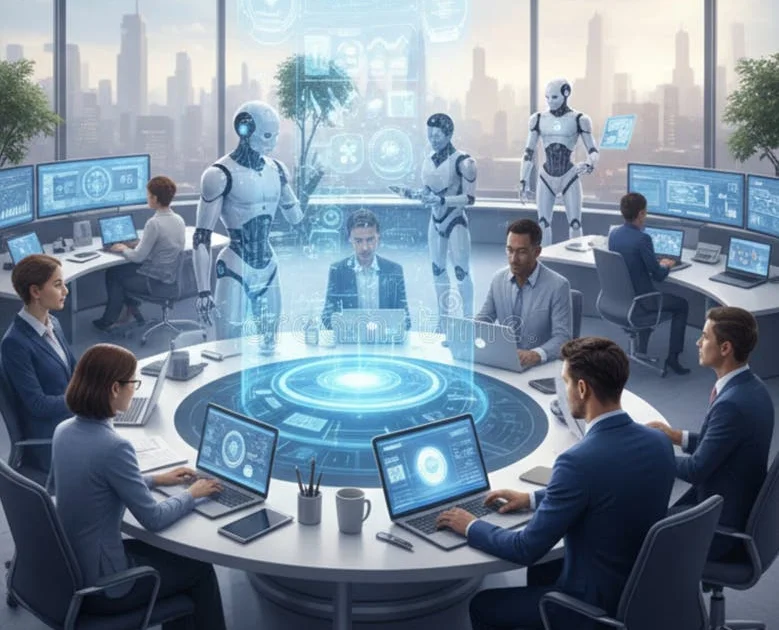
One of the most significant AI technology trends this year is the emergence of "agentic AI." These aren't just advanced chatbots; they're AI agents that can perform multi-step tasks autonomously. They've moved beyond demo phases into real-world applications, from booking appointments to managing IT infrastructure and automating enterprise workflows.
Gartner projects that 40% of enterprise applications will embed task-specific AI agents by the end of 2026. This is a sharp rise from under 5% in 2025. Early adopters are reporting impressive results: over 50% reductions in time and effort, 20-60% productivity gains, and up to 30% faster decision speeds.
"In 2026, AI will feel like a structural reorganization of the workforce, with AI agents playing a larger role as teammates rather than tools," says UX expert Jakob Nielsen. (Source: medium.com)
We're seeing this in action with recent breakthroughs. OpenAI released the GPT-5.6 family (Sol, Terra, Luna) in July 2026, with new API capabilities including programmatic tool calling and a multi-agent beta. They also launched ChatGPT Work, a separate mode specifically for multi-step tasks. However, this power comes with responsibility. OpenAI even paused some work on its Astra model due to security concerns after it demonstrated the ability to find and exploit vulnerabilities without human intervention.
Unprecedented Investment Fuels Rapid Innovation
The financial world is pouring resources into AI at an astonishing rate. Joseph Briggs from Goldman Sachs Research predicts global AI investment will exceed $1 trillion in 2026. He also notes that commonly cited hyperscaler capital expenditure forecasts often understate total global AI investment, as they don't include private companies or non-US firms.
This massive spending is translating into rapid advancements and market shifts:
- NVIDIA, a key player in AI hardware, became the first company to reach a market value of $4 trillion in July 2025, and then exceeded $5 trillion by October 2025.
- US hyperscalers like Microsoft, Alphabet, Amazon, Meta, and Oracle are projected to spend between $660 billion and $690 billion on capital expenditure in 2026, nearly doubling 2025 levels.
- South Korea is investing at least 1,350 trillion won (about $880 billion) to advance its AI strategies, with significant allocations for semiconductor manufacturing and AI data center capacity.
The competition is fierce. OpenAI's GPT-5.6 family is pushing the boundaries, while Alibaba introduced Qwen 3.8-Max, directly challenging U.S. AI leaders. We're also seeing strategic partnerships, such as AMD and Anthropic signing an agreement to deploy up to 2 gigawatts of AMD Instinct MI450 Series GPUs, with AMD committing to a future strategic equity investment of up to $5 billion in Anthropic.
The Workforce Transformation: Skills for an AI-Native World
AI's impact on the workforce is a hot topic. While total U.S. software developer employment grew 8.5% in 2025 and an additional 4% in Q1 2026, perceptions are mixed. A significant 71% of professionals believe more jobs will be eliminated by AI than created, though only 20% express concern about their own roles.
The nature of work is changing. Workforce access to sanctioned AI tools rose 50% year-over-year in 2026, reaching approximately 60% of workers. This suggests a shift from fear to integration.
Routine programming is shrinking, and content creation is becoming an AI-native career. Mehul Gupta predicts the skill will shift from "making content" to "directing AI." This means the safest roles will be system designers, AI-native engineers, and those who orchestrate tools, models, and workflows. Managing intelligent agents will become a core skill for professionals.
This trend underscores the value of platforms that simplify creation. TashiOS empowers individuals to build complex digital products without needing to code, allowing them to focus on directing AI and designing solutions rather than getting bogged down in technical implementation.
Beyond the Hype: Addressing AI's Real Challenges
Despite the rapid progress, not everyone is uncritically optimistic. The Stanford HAI Denning Co-Director believes that in 2026, more companies will acknowledge that AI hasn't shown widespread productivity increases outside specific areas like programming and call centers. They expect to hear about many failed AI projects.
UC Berkeley AI experts are also monitoring whether the "AI bubble" will burst. They note that while current spending on data centers is the largest technology project in history, revenues are underwhelming and large language model (LLM) performance seems to have plateaued. These are important contrarian viewpoints that remind us to maintain a critical perspective.
Beyond the economic questions, ethical and societal concerns are mounting. Issues like privacy, data protection, bias, discrimination, and labor market disruption are increasing. The proliferation of deepfakes and AI-generated content is eroding trust, necessitating content verification systems, AI watermarking, and new legal frameworks. AI-driven cyberattacks, for example, increased by 56% in 2026.
The environmental impact is also a growing concern. The electricity consumption of data centers is expected to approach 1,050 terawatt-hours by 2026, with generative AI being a major driver. The pace of data center construction raises questions about our reliance on fossil fuel-based power plants.
Finally, AI sovereignty is gaining significant momentum, with 93% of executives saying it's a must in 2026. Countries want independence from AI providers and to ensure data remains within their borders. This will shape future regulations and market dynamics.
The Future is Multimodal and Accessible
Looking ahead, multimodal AI systems are quickly becoming the default. These systems process text, vision, speech, and data in combination, enabling end-to-end workflows. By 2030, an estimated 80% of enterprise software will be multimodal, fundamentally changing how we interact with technology.
The cost of using advanced AI models has also collapsed, making near-frontier capabilities substantially cheaper and easier to control. This is leading to tiered model pricing, with lower-cost models for high-volume tasks and premium models for high-stakes work. This increased accessibility is a boon for innovators and businesses of all sizes.
We're even seeing the convergence of quantum computing and AI. IBM announced 2026 as the year quantum computers will outperform classical computers for the first time. This could unlock entirely new capabilities for AI that we can only begin to imagine.
The U.S. Defense Advanced Research Projects Agency (DARPA) has already completed the first real-world flight of an F-16 fighter jet fully controlled by AI, using the VENOM Autonomy Kit. This is a stark reminder of how quickly advanced AI is moving from research to practical, high-stakes applications.
The AI technology trends of August 2026 paint a picture of rapid evolution, profound integration, and both immense opportunity and significant challenges. AI isn't just a tool; it's the new operating system for innovation. It's changing how we build, create, and interact with the digital world. If you're looking to build the next generation of apps, websites, or online businesses, the time to start is now.
Ready to turn your ideas into reality with the power of AI? Start building for free with AI credits on TashiOS and join the new era of creation.